A stamp, or quality mark, is a few letters or numbers on the metal that say what it's made of. Here's what the common ones mean under the FTC Jewelry Guides and the federal stamping law.
Where to look
One fineness of gold can be hard to tell from another by eye, so GIA suggests looking for the quality mark stamped inside a ring.
10K, 14K, 18K, and 24K
Karat counts parts of gold out of 24. GIA explains that 24K is pure gold, 18K is 75 percent gold, and 14K is 58.3 percent. That's why you'll also see numbers in parts per thousand: 750 for 18K, 583 or 585 for 14K, and 417 for 10K.
Under the FTC Jewelry Guides, "gold" on its own means 24 karat all the way through. Anything less needs the karat right before it, as in "14K" or "14 Kt. Gold."
Federal law sets the margin. A gold piece can test no more than 3 parts per thousand below its mark. Counting the solder, the limit is 7 parts per thousand for most jewelry.
925 and sterling
925 means 925 parts per thousand silver. The FTC guides save "sterling" and "Ster." for silver that's at least 925/1,000 pure, and "coin silver" for at least 900. The word "silver" alone needs a number in front, such as "750 silver." By law, sterling can test up to 4 parts per thousand low, or 10 counting solder.
GF: gold filled
GF means a layer of gold alloy, at least 10 karat, bonded on by mechanical means such as soldering or welding, that makes up at least 1/20 of the metal's weight. The karat comes first, as in "14K GF."
GP, RGP, and GEP: gold plated
A mechanically bonded layer of at least 10 karat that makes up at least 1/40 of the weight can be called gold plate, rolled gold plate (RGP), or gold overlay. RGP and overlay marks add the fraction, as in "1/40 12 Kt. R.G.P."
Electroplate (GEP) needs gold of at least 10 karat, with a thickness equal to at least 0.175 microns of fine gold. At 2.5 microns, it can be called heavy gold electroplate. Each mark should carry the karat of the plating, as in "12K G.E.P."
The stamping law adds two rules. A plated or filled piece can't carry a gold mark like 14K unless words say it's plated or filled. And it can never be stamped "sterling" or "coin."
Vermeil
Vermeil is sterling silver coated with gold of at least 10 karat, at least 2.5 microns thick. If a base metal such as nickel sits between the silver and the gold, the FTC guides say the seller should disclose it.
Rhodium
White metals are often plated with rhodium. GIA notes white gold usually is, and that the plating wears away over time. The FTC guides say a rhodium surface layer on a precious metal piece should be disclosed.
The maker's mark
A quality mark shouldn't stand alone. Under federal law, whoever stamps a gold or silver quality mark also has to apply their trademark or name the same way, at least as large, and as close to the mark as possible.
No stamp can suggest the U.S. government checked it. The law makes marks like "United States assay" unlawful.
What a stamp doesn't tell you
A stamp is the maker's claim about precious metal. It doesn't say whether the rest of the alloy, or the metal under a plating, contains nickel. For that, read Jewelry for sensitive skin. For what each label means in a listing, read Gold plated, gold filled, or solid gold.
On this shelf
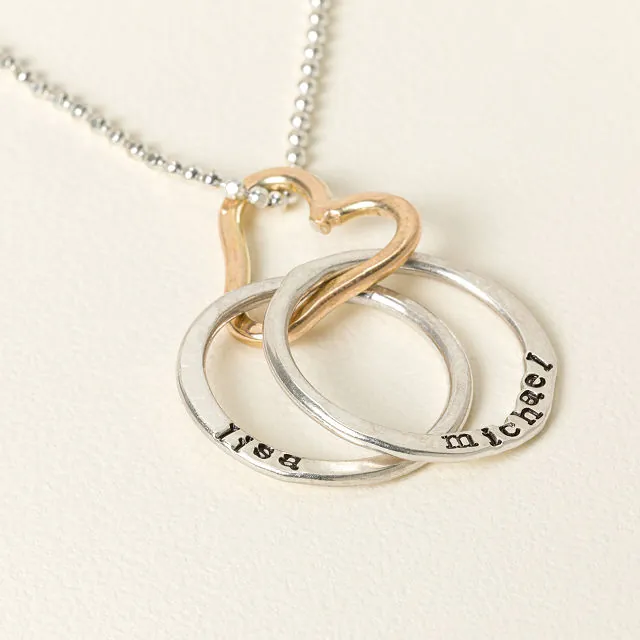
We go by each store's listing, not the stamp itself. The EonLuxe bracelet is listed as solid 925 sterling silver with 18K gold plating. The Amoris Votum necklace pairs a 925 sterling silver chain with a rhodium-sealed brass pendant. The book necklace is 24K gold-fill over brass, on a 14K gold-plated chain. The All Heart necklace joins sterling discs with a gold-filled heart. The birthstone stacking rings are listed as gold filled, and the raw birthstone studs as sterling silver.